Table of Contents
If you are a real estate agent in Australia, your next client showing high levels of intent is almost certainly searching for you on Google (even with AI, users are still making decisions using traditional search). Whether they are typing “buyers agent in Melbourne” or “property management Parramatta,” the agencies that appear at the top of those results are the ones winning the enquiries – in this guide we’ll run through the essentials to have a chance of climbing those Google rankings.
The good news is that real estate SEO is learnable. The better news is that most agencies are not doing it well, which means there is a real opportunity to get ahead of the competition, even in crowded markets like Sydney, Melbourne and Brisbane.
This guide walks you through everything you need to know: from the foundations of how Google ranks real estate websites, to optimising your listings, building local authority, and measuring whether it is working.
The Foundations of Real Estate SEO
Why Real Estate Is Different
SEO for real estate is not the same as SEO for a café or a law firm. Property websites have some unique characteristics that affect how they are built and ranked.
As anyone with experience in the industry knows, competition is fierce. You are not just up against other local agencies, you are competing with national portals like realestate.com.au and Domain, which have enormous domain authority and budgets. The key is not to try to outrank the portals for generic terms, but to own your local market for the searches that matter most to your business.
On top of this, listings are dynamic. Property pages go live and change in status constantly, which creates technical challenges around the need for redirects, managing duplicate content, thin pages, and crawl efficiency. A well-structured real estate website manages this thoughtfully.
Finally, local intent dominates. Almost every valuable search in real estate has a geographic component. Google knows this, and its algorithm heavily rewards websites with genuine local authority and the content to prove it.
Technical Foundations
Before you can climb those Google rankings, Google and other search engines needs to be able to find, crawl, and understand your website. The technical basics that matter most for real estate sites are:
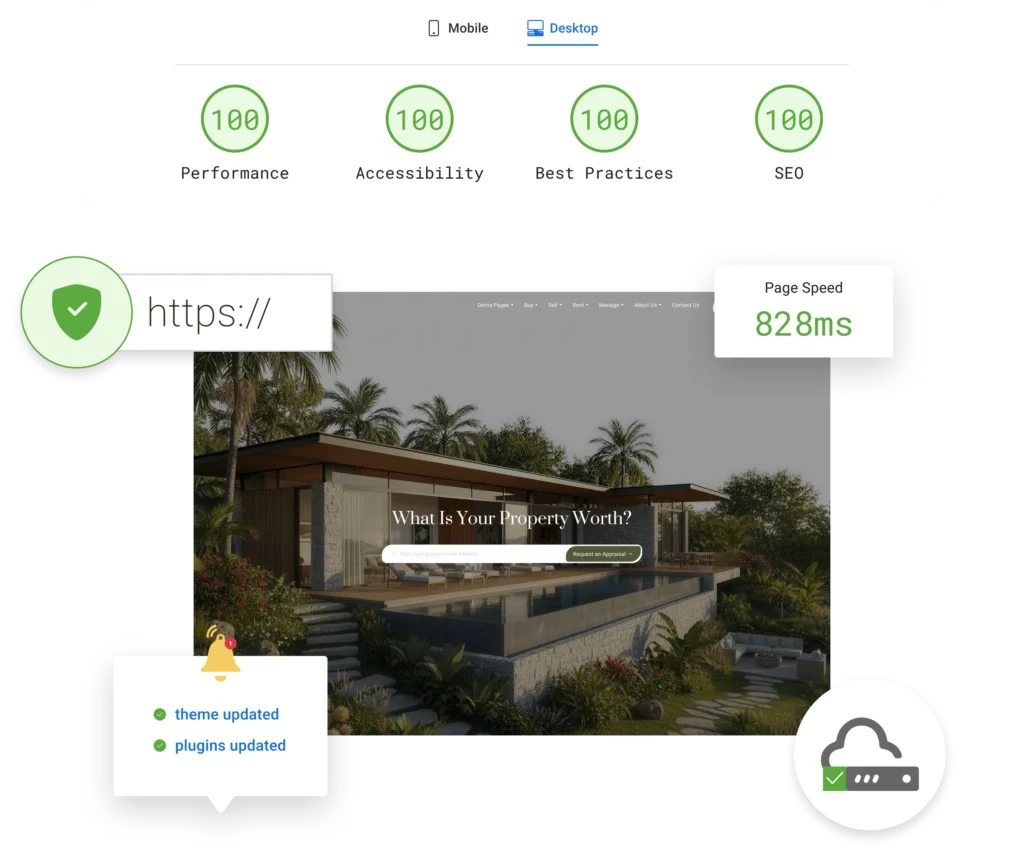
- Site speed: Property websites are often image-heavy. Slow load times hurt both rankings and user experience. Compress images, use a content delivery network, and ensure your hosting is fast and reliable. Where possible, don’t use bloated themes or templates.
- Mobile optimisation: Most property searches happen on mobile. Google uses mobile-first indexing, meaning it primarily uses your mobile site to determine rankings. If your mobile experience is poor, your rankings will suffer regardless of how good your desktop site looks.
- Clean URL structure: URLs like
/properties/sydney/addressare far more useful to Google than/listing?id=48291. A logical, descriptive URL structure helps both crawlers and users. - XML sitemap and robots.txt: Make sure Google and its crawlers can find all of your important pages, and that you are not accidentally blocking anything valuable.
Optimising Your Property Listings for Search
Individual property listing pages are an underused SEO asset. Most agencies treat them as functional displays of information rather than opportunities to rank.
Write for Search Intent, Not Just Buyers
When writing listing descriptions, think about the language people actually use when searching. A buyer looking for a family home in Caulfield is likely typing “4 bedroom house Caulfield” or “family home near Caulfield Primary School.” Weaving these natural phrases into your descriptions, without keyword stuffing, helps Google understand what each page is about.
Suburb names, property types, nearby landmarks, and school zones are all fair game. The goal is natural, readable copy that also signals relevance to Google.
Structured Data (Schema Markup)
Structured data is specific code you add to your pages that helps Google understand the content more precisely. For real estate, there is specific schema for residential listings that can help your pages appear with richer information in search results. This is a technical implementation, but it is worth the investment, particularly for agencies with large listing volumes. Warning: if the schema data includes one character (e.g. a comma, bracket) that is out of place or incorrect, the whole file for that page is invalid.
Image Optimisation
Real estate pages are full of photos, and most of them are invisible to Google without help. Add descriptive alt text to images (for example, “kitchen with stone benchtop in Northcote townhouse”) and compress files to keep page speed high.
Managing Expired Listings
When a property sells or is leased, do not simply delete the page. Redirect it to a sold version of the listing, or if not possible, relevant suburb page or an archive, preserving any authority that page had accumulated. A site full of dead URLs is a technical problem that compounds over time.
Local SEO for Real Estate Agents
Local SEO is where most real estate agencies should be concentrating their effort. A strong local presence means appearing in Google Maps, the local pack (the map results that appear for location-based searches), and the organic results for suburb-specific queries.
Google Business Profile
Your Google Business Profile (formerly Google My Business) is one of the most powerful free tools available to real estate agents. A well-optimised profile can put you in front of potential clients who are actively searching for agents in your area.
Key steps to optimise your profile:
- Ensure your business name, address, and phone number (NAP) are accurate and consistent with what appears on your website
- Choose the right business categories (Real Estate Agency is primary; you can add Property Management, Estate Agent, and others)
- Upload high-quality photos of your office, team, and sold properties
- Request reviews from satisfied clients. Google reviews are a significant ranking factor for local results
- Post regular updates to signal that your profile is active
NAP Consistency
Your business name, address, and phone number must be identical across every online directory, social profile, and listing where your agency appears. Inconsistencies confuse Google and dilute your local authority. Conduct an audit of your citations, including realestate.com.au, Domain, True Local, and any chamber of commerce or industry directory listings, and clean up any discrepancies.
Suburb-Specific Landing Pages
If your agency operates across multiple suburbs, create a dedicated page for each one. A page targeting “property management in Randwick” is far more likely to rank for that term than a generic services page that mentions Randwick in passing.
Each suburb page should include:
- A unique description of your service in that area (not copied from other suburb pages)
- Local statistics or market insights where relevant
- Testimonials from clients in that suburb
- A clear call to action
These pages compound over time. The more suburb authority you build, the harder it becomes for competitors to displace you.
Building Local Links
Gone are the days of old-hack link farming. These days, it’s about the quality and relevance. Links from other local websites (industry awards or recognition, local newspapers, business associations, and complementary services like mortgage brokers or conveyancers) are powerful signals of local relevance. Building genuine relationships in your community is one of the most sustainable link-building strategies available.
Tracking Your SEO Performance
There is little point investing in SEO without knowing whether it is working. The good news is that the most important tracking tools are free.
Google Search Console
Google Search Console shows you exactly which queries are bringing people to your website, which pages are ranking, and how often people are clicking through. It also alerts you to technical issues like crawl errors and manual penalties.
Key things to monitor in Search Console:
- Total clicks and impressions: Is your overall visibility growing over time?
- Average position: Are your key pages moving up or down in rankings?
- Click-through rate (CTR): Are people choosing your result over others? A low CTR despite good rankings suggests your title tags and meta descriptions need work.
- Core Web Vitals: Google’s page experience signals, including load speed and visual stability.
Google Analytics
Where Search Console tells you about your search visibility, Google Analytics tells you what visitors do once they arrive. Track organic traffic as a channel, monitor which pages attract the most visitors, and, most importantly, set up goal tracking for enquiry form submissions, phone click-throughs, and appraisal requests.
Key Metrics to Watch
- Organic sessions: The volume of visitors arriving from Google search
- Keyword rankings: Track your position (the average position in the Google rankings) for target terms using a rank tracking tool (Ahrefs and SEMrush are popular options)
- Local pack appearances: How often does your Google Business Profile appear for local searches?
- Conversion rate from organic traffic: Of all the people who find you via Google, how many make an enquiry?
SEO is a long game. Expect meaningful movement over three to six months, with compounding results over 12 months and beyond.
Common Mistakes Real Estate Agencies Make with SEO
Understanding what not to do is just as valuable as knowing the right approach.
Assuming a CRM provider knows how to build a good website: We see so many agencies with templates sites built by a CRM provider. These may be more affordable and faster to spin up, but they often lack the fundamentals for SEO.
Thin or duplicate suburb pages: Creating dozens of suburb pages that are essentially identical, with only the suburb name swapped out, is one of the most common mistakes. Google penalises this as duplicate content. Every suburb page must offer genuinely unique value.
Ignoring Google Business Profile: Many agencies set up a profile once and never return to it. An incomplete or inactive profile is a missed opportunity in a channel where your competitors may be far more active.
Neglecting mobile experience: A website that looks beautiful on desktop but is frustrating on mobile is losing a large proportion of potential enquiries. Test your site regularly on multiple devices.
Chasing national terms instead of local ones: Trying to rank for “real estate agent” nationally is not a realistic or worthwhile goal for most agencies. Dominating your local suburbs is far more achievable and far more valuable.
No strategy for expired listings: As covered above, simply deleting sold or leased listings discards the SEO value they have built up. Always redirect or archive thoughtfully.
Not measuring anything: It is surprisingly common for agencies to invest in SEO without setting up proper tracking. If you cannot measure it, you cannot improve it.
Where to from Here?
Improving your real estate website’s Google rankings is not a one-time project: it is an ongoing investment in the most cost-effective lead generation channel available to agents. The agencies that commit to it consistently are the ones that build sustainable pipelines of inbound enquiries.
If you are not sure where your website currently stands, the best starting point is an SEO audit. This gives you a clear picture of technical issues, keyword opportunities, and competitive gaps, so you can prioritise your effort and investment wisely.
Real Coder specialises in SEO for Australian real estate businesses. We understand the competitive dynamics of property markets across Sydney, Melbourne, Brisbane, and beyond, and we build strategies that deliver measurable results.
Get a free SEO audit for your real estate website or explore our real estate SEO services to find out what is possible for your agency.